Wildlife in Motion: Silhouettes, Close Encounters, and Shifting Natural Landscapes
LunarFathom
Updated
Advertisement
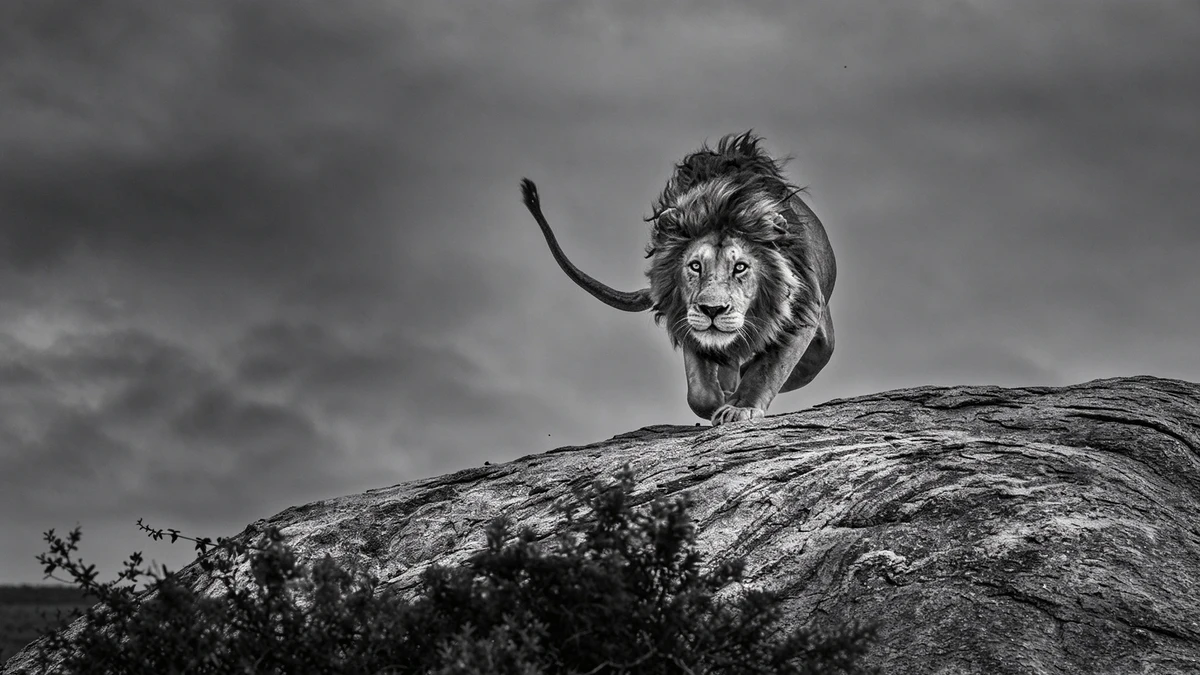
A lion poised above the rocky slope
A male lion stands near the crest of a broad rock outcrop, facing forward as his tail curves behind him. The low viewpoint gives the stone a substantial presence: its ridges and cracks fill much of the foreground, while the lion appears against an open, clouded sky. That arrangement draws attention to the animal’s mane and alert face without losing the weight of the landscape beneath him. Dark shrubs at the bottom edge add another layer of depth, their fine branches contrasting with the smoother sky and the rock’s rough surface.
The monochrome treatment brings the scene together through shades of gray, emphasizing texture rather than color. Light catches parts of the lion’s face and mane, while the darker body stands apart from the clouds. The rock’s sloping line leads the eye toward the animal, making the ridge feel like a natural stage without needing extra scenery. His forward-facing posture gives the frame a directness that contrasts with the sweeping, open space around him. The result is a tightly composed wildlife portrait in which a few clear shapes—the lion, the ridge, and the sky—carry the whole image.
Advertisement
About the Author
LunarFathom
Connector of dots across disciplines, delivering context you can trust.















Comments
Leave a Comment
Your email address will not be published. Required fields are marked *